How to wind down at night with yoga
You're exhausted. You've been up since six, you've got nothing left, and you get into bed fully expecting to be asleep in minutes. Then you're not. Your body is heavy but your mind is running. An hour later you're still there, more frustrated than when you started.
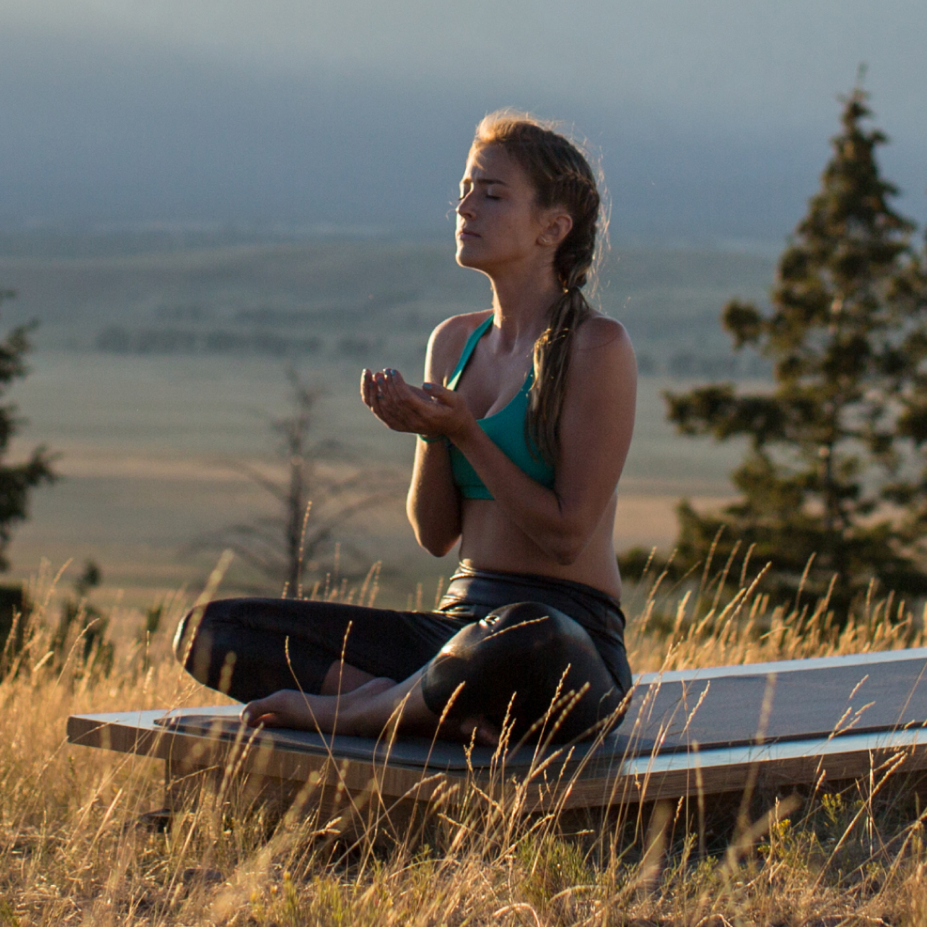
"Breathe out the day. Breathe in peace" points at what's missing. Not more tiredness. A transition. Your body needs a signal that the day is actually over, and most nights it never gets one.
Why tired isn't the same as ready
Being tired and being ready for sleep are two different states. You can be completely depleted and still wired. That's because sleep is something your nervous system allows once it decides you're safe. Heart rate down. Breathing slow. Those things happen on their own schedule, and being exhausted doesn't speed them up.
Many days end without any of that happening. You work until you stop working. You handle the evening. You go from full activation straight to lying in the dark. Nothing in between told your system the demands were over. So it stays alert. And lying still with a busy mind is one of the more frustrating experiences available.
Collapsing versus winding down
The default wind-down is a couch and a screen. It feels like rest because you've stopped moving. But your nervous system is reading input. And a screen is input. Light, story, notifications, the small hits of engagement that keep your brain interested.
Scrolling has the same problem. Your body is still, your attention is being pulled around constantly, and the tension you accumulated all day stays exactly where it was. Stopping and downshifting aren't the same thing. Stopping is passive. Downshifting takes a little participation.
That's the useful part: it's not more effort. Ten or twenty minutes of the right kind of input does more than two hours of the wrong kind.
Moving the day out of your body
The day is still in you physically. Gentle movement gives that somewhere to go. Just enough motion to unstick what's been held. Moon salutations are built for this. The whole sequence moves in the opposite direction from morning practice. Slower. Softer. Side to side rather than driving forward. It's a flow that takes energy down.
Repetition helps here too. A sequence you don't have to think about lets your mind stop managing. You're moving, but you're not deciding anything.By the end, your body has processed something. The tension you were carrying at 8pm isn't the tension you're taking to bed.
Letting the floor hold you
Restorative work is different. Barely any movement. Mostly you're supported and you stay there. That's the point. Restorative poses use props to hold your body so your muscles can stop working. When nothing has to be held up, your nervous system gets a clear message that effort is over.
Twenty minutes of being supported does more for sleep than you might expect. It's giving your system the conditions it needs to shift states. This also works on nights when you have zero capacity for anything else. Some evenings you can't manage even a gentle flow. Restorative asks almost nothing of you.
Breath as the fastest route
Breath is the most direct lever you have on your nervous system. Long exhales are the mechanism. When you breathe out longer than you breathe in, your heart rate drops and your parasympathetic system takes over. It's a physical response you can trigger deliberately.
That's why breathwork changes your state faster than almost anything else. A few minutes of extended exhales can move you from wired to settled when nothing else has worked. It also travels. Once you know the pattern, you can use it lying in bed after the practice is over. On the nights you wake at three and can't get back down, this is the tool.
Emptying your head and finding peace
The mental part is usually what keeps people awake. The body settles and the mind won't. Meditation at night is about giving your attention something other than tomorrow's problems to hold onto.
A nighttime abundance practice does that by shifting what you're focused on. You're gathering up what was good. It's a redirect. Your mind will land somewhere, this just chooses where. Ending the day in that register also changes what you carry into sleep. Lying awake cataloguing your failures keeps your system activated. There's a physiological difference between those two states, not just an emotional one.
When sleep still doesn't come
Some nights it doesn't work. New environment, too much coffee, something on your mind that won't resolve. Yoga nidra is for those nights. It's a guided practice that brings you into deep rest whether or not you fall asleep. The rest itself is restorative, so the night isn't wasted even if you stay conscious through it.
Plenty of people fall asleep partway through and never hear the end. That's a fine outcome. The practice isn't asking you to stay awake. It also solves the problem of lying in bed trying to sleep, which is its own trap. Trying harder to sleep is the one thing guaranteed not to work. Yoga nidra gives you something to do that isn't trying.
Building the routine
The reason bedtime routines fail isn't that people don't believe in them. It's that they take too long and require more than anyone has left at 10pm. Ten to twenty minutes is different. That's achievable on a normal night. And the consistency matters more than the length. Your body starts recognizing the signal and downshifting faster.
Pick what matches the night. Physically restless and full of unspent energy? Moon salutations. Wrung out with nothing left? Restorative. Mind won't stop? Breathwork or meditation. Already in bed and it's not happening? Yoga nidra.
You don't need all of it, and you don't need it every night. You need something that reliably tells your body the day is done.
Press play for better sleep
Ready to end the day differently? Roll out your mat. This week's featured Binge-Worthy Nighttime Chill playlist includes:
Moon Salutation Flow
Quick Restorative
Breathe into Bliss
Nighttime Abundance Meditation
Yoga Nidra Visualization
Ten to twenty minutes each. Take one before bed, or stack a few on the nights that need it.

A Gentle Practice for Moving Stuck Energy
Energy blocks sound abstract until you notice how often you already feel them. The tight chest when anxiety hits. The knot in your stomach under stress. Shoulders climbing toward your ears when everything piles on. These

YogaToday Blog: How to Get On the Mat More Consistently
Most fitness advice tells you to push harder. Do more. Suffer through. But real power comes from showing up consistently. You can claim your space and take up the room you need to take care of yourself.

The truth about mindful weight loss: Why awareness beats willpower
Weight loss advice tells you what to do but never how to actually listen to your body. Every diet promises the same thing: follow our rules and find a way to push through.